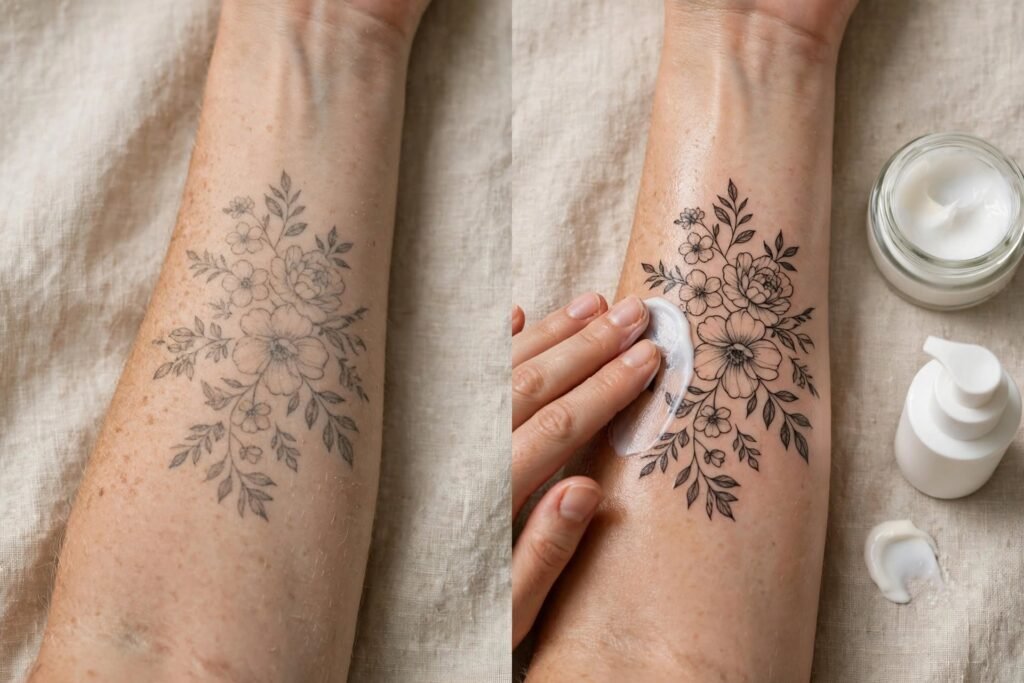
At some point with most tattoos, you’ll find yourself looking at a piece that isn’t looking the way you want it to and trying to decide what to do. The options are either going back to the artist for a touch-up or committing to a proper ongoing care routine. Sometimes the answer is clearly one or the other. Sometimes it’s both. Knowing how to tell the difference saves time, money, and the experience of getting a touch-up on a tattoo that just needed better aftercare.
What Touch-Ups Are For
A touch-up is the appropriate response when there is a genuine structural issue with the tattoo that skincare cannot address. These are situations where ink is missing, lines have broken down, or the design has a problem that exists in the dermis rather than at the skin surface.
Patchy Healing
If a tattoo healed with light spots, gaps in lines, or areas where color didn’t hold, those are ink-loss issues. The ink that should be there isn’t, either because it was pulled out during heavy scabbing, because the skin rejected it during healing, or because it wasn’t deposited properly in the first place. No moisturizer puts ink back into the dermis. A touch-up does.
The right time for this touch-up is after the tattoo has fully healed, at least three to four months after the original session, and ideally closer to six for larger pieces. Going back in too early means the skin is still healing and the artist can’t accurately assess what needs work.
Significant Line Softening From Age
Fine lines and detailed work soften over time as ink naturally migrates through the dermis. For styles where line definition is fundamental to the design, geometric work, fine line botanicals, portraits, softening that reaches the point where the design loses its intended appearance is a legitimate reason for a touch-up.
This is different from the gradual, even softening that every tattoo experiences as it ages. It’s the point where the softening is significant enough that the piece no longer looks the way it was designed to look.
Color Loss From UV Damage
UV-driven color fading is real and irreversible through skincare. Pigment that has been broken down by UV radiation is gone, and a touch-up with fresh pigment is the only way to restore the color. This is most commonly relevant for colored tattoos on regularly sun-exposed areas that haven’t been consistently protected.
What Ongoing Tattoo Care Is For
Tattoo care, moisturizing, sun protection, and general skin maintenance, addresses the surface condition of the skin and slows the environmental factors that drive long-term changes. It’s not a substitute for a touch-up when one is genuinely needed, but it handles the majority of what affects tattoo appearance over time.
Surface Dullness
A tattoo that looks flat or washed out is not always faded. Dry, neglected skin makes ink look dull even when the pigment is largely intact. Starting a consistent daily moisturizing routine frequently produces a noticeable improvement in tattoo appearance over four to six weeks without any new ink.
This is the most common situation where people consider a touch-up prematurely. The tattoo looks worse than expected, the assumption is that it’s faded, and a touch-up seems like the solution. In many cases, improving the skin condition first reveals that the ink is in better shape than it looked, and the touch-up either becomes unnecessary or becomes much smaller in scope.
Ongoing Fading Prevention
Once a tattoo is in good shape, either fresh or freshly touched up, ongoing care is what keeps it that way. Consistent sunscreen application prevents UV-driven fading from accumulating. Daily moisturizing maintains the skin condition that lets ink look its best. Neither is dramatic or time-consuming, and both have a measurable effect on how the tattoo looks at the five and ten year mark.
How to Tell Which One You Need
The practical approach is to start with skincare and give it time before deciding about a touch-up.
If the tattoo looks dull or flat, start daily moisturizing and consistent sun protection and give it six weeks. If the appearance improves significantly, the issue was skin condition and the touch-up may not be needed. If it doesn’t improve meaningfully, the issue is more likely genuine ink loss.
If there are clearly visible gaps in lines, areas without color where there should be color, or the design has structural issues that haven’t changed with improved skin care, that’s a touch-up situation.
If the tattoo has aged significantly over years and lines that used to be crisp have genuinely softened to the point of affecting the design, that’s a touch-up situation alongside a commitment to better ongoing care to preserve the new work.
Getting the Most Out of a Touch-Up
If you do decide a touch-up is the right call, going into it with the skin in good condition makes a real difference in the outcome. Touch-up ink deposits and heals better in well-maintained skin than in skin that has been neglected. The same conditions that affect original tattoo healing, skin hydration, barrier function, overall skin health, affect how touch-up work heals.
Build the skincare routine before the touch-up appointment, not after. Arriving at the session with consistently moisturized, healthy skin gives the artist a better working surface and gives the new ink better conditions to settle into.
After the touch-up, maintain the routine that keeps the new work looking good. A touch-up on a tattoo that goes back to being neglected will need another touch-up sooner than a touch-up on a tattoo that gets consistent, basic maintenance from that point forward.