
The connection between aftercare and studio marketing is one that doesn’t get talked about enough in business conversations about running a tattoo studio. Artists and owners think about their Instagram presence, their portfolio, their booking system, their pricing. Aftercare sits in a different category in most people’s minds, client care, not marketing. But the two are more connected than they appear, and understanding that connection changes how you think about what happens after a client walks out the door.
Healed Photos Are the Most Effective Marketing Tattoo Studios Have
Fresh tattoo photos are what most people post. The color is at its most saturated, the lines are sharpest, the piece looks its most dramatic right after it’s done. Fresh photos get attention and they look impressive.
But clients booking tattoos are not making decisions based on what they see right after the session. They’re making decisions about what they’ll be wearing on their skin for the rest of their lives. Healed photos show them that. A portfolio full of well-healed tattoos tells a potential client something that a portfolio of only fresh work doesn’t, that the work holds up, that the lines stay clean, that the colors settle the way they’re supposed to.
Artists who post healed work consistently report that it drives bookings differently than fresh photos do. The inquiries from healed posts tend to come from clients who are more seriously considering booking rather than just browsing. They’ve seen what the healed result looks like and they’ve decided that’s what they want.
For this marketing approach to work, the healed photos need to look good. And that depends on how the client took care of the tattoo during and after healing.
What Poor Aftercare Does to Healed Photos
A tattoo that healed with heavy scabbing often shows it in the healed result. Light spots where ink was pulled out. Uneven color in filled areas. Lines that look slightly broken rather than clean. These are all things that show up in healed photos, things that a potential client looking at the portfolio will notice even if they don’t know exactly what caused them.
An artist whose healed photos show consistent patchiness, uneven healing, or ink loss is working against their own marketing even if the fresh work is technically excellent. The healed photos tell a story the artist didn’t intend.
The frustrating part of this is that the healing issues causing these photo problems are often not the artist’s fault. The application was fine. The client went home and used the wrong product, picked at the peeling skin, or let it dry out during the critical first week. The outcome reflects on the work rather than on the aftercare decision that caused it.
How Stocking Quality Aftercare Changes the Outcome
When the studio controls what goes on the tattoo after the session, by stocking quality aftercare and making a clear recommendation that clients actually follow, the healing outcomes become more consistent. Clients using a well-formulated aftercare balm from the start of healing are less likely to experience the heavy scabbing, picking temptation, and product reactions that cause the healing problems visible in healed photos.
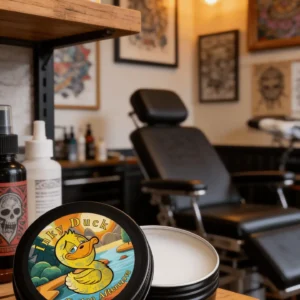
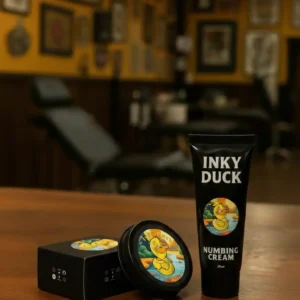
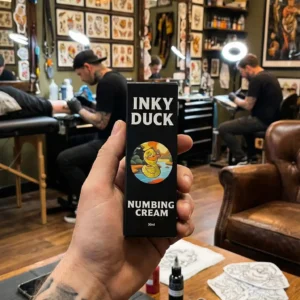
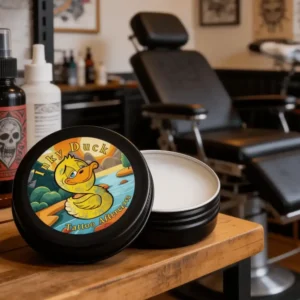
Brands like Inky Duck build their products around this outcome. Fragrance-free, formulated for healing skin, clear application instructions. A client who leaves with this product in hand and follows the instructions has a better healing experience than one who guesses their way through with whatever was in the bathroom cabinet. That better healing experience produces a healed tattoo that looks the way it’s supposed to look, which is what shows up in the healed photo.
Studios that consistently stock and recommend quality aftercare see more consistent healed results across their portfolio. More consistent healed results mean a portfolio of healed photos that genuinely reflects the quality of the work. A portfolio that genuinely reflects the quality of the work drives more and better bookings.
The Referral Connection
Client referrals are one of the most reliable drivers of new business for tattoo studios. People who love their tattoo tell the people around them about it. The conversation usually includes where they got it and what the experience was like, from booking through healing.
A client who heals well is a client with a story worth telling. They went in, the artist did great work, they followed the aftercare routine, the tattoo healed cleanly, and now they’re wearing something they’re proud of. That’s a complete, positive story that ends with a referral.
A client who healed poorly has a more complicated story. Even if they understand intellectually that the healing issues were related to their own aftercare choices rather than the artist’s work, the experience left a shadow over what should have been a straightforwardly positive one. The referrals from this client are fewer and less enthusiastic than they would have been from a good healing experience.
Studios that actively support good healing outcomes through quality in-shop aftercare are investing in the referral quality of every client who walks out the door. The return on that investment shows up in new client inquiries, not on a product sales report, but it’s real and it compounds over time.
Building the Feedback Loop
The most practically useful thing studios can do to connect aftercare to marketing is to actively collect healed photos from clients. A follow-up message at the six to eight week mark, when the surface healing is complete and the tattoo is showing close to its final settled appearance, asking clients to share their healed result creates a consistent stream of healed content.
Clients who have healed well are happy to share. They’re proud of the tattoo, the healing went smoothly, and they’re in a positive relationship with the studio. A simple message acknowledging that the healing period should be wrapping up and asking if they’d be willing to share a photo is all it takes for most of them.
This content pipeline, fueled by consistent good healing outcomes, which are fueled by consistent quality aftercare recommendations, is what builds a healed photo portfolio over time. It doesn’t happen from a single client or a single cycle. It builds across months and years as the studio accumulates a consistent record of work that healed well because the clients had what they needed to make it happen.