
If you’ve been tattooing for more than a few months, you know the pattern. The session ends, the client leaves with an aftercare sheet, and within 24 to 48 hours the messages start. Is this normal? What should I put on it? Can I use this lotion I have? My skin is doing this thing, is that okay?
These questions are not a sign that clients aren’t listening. They’re a sign that aftercare is genuinely confusing when you send people home to figure it out without a clear product in hand. Stocking aftercare in-shop and making it part of the standard post-session handoff is one of the most effective ways to reduce this message volume while improving client outcomes at the same time.
Why Clients Ask So Many Aftercare Questions
The root of most aftercare questions is uncertainty about what to use. Clients leave the studio knowing they need to clean and moisturize the tattoo, but without a specific product recommendation they’re standing in a pharmacy aisle looking at fifteen options and trying to remember whether the artist said anything about fragrance or petroleum or alcohol.
Some make a good choice. Others grab whatever looks relevant and discover the problem later when the tattoo is itching more than expected or developing heavier scabbing than seems normal. Then the questions come.
The confusion is not about the process, most clients understand the basics of keep it clean and keep it moisturized. The confusion is about the product, and that confusion creates a constant low-level support burden for artists who are trying to focus on their next session rather than troubleshooting someone’s choice of body lotion.
How Stocking Aftercare Changes the Dynamic
When a client leaves with a specific product in hand, the decision is already made. There’s no pharmacy aisle moment. There’s no guessing game. The artist said use this, here it is, the instructions are clear.
This shifts the nature of the questions that do come in. Instead of “what should I use?” clients ask “I’m using what you gave me and my skin is doing X, is that normal?” That’s a much easier question to field, and it’s also a question with a cleaner answer because you know exactly what product is on the skin.
The total message volume drops because the primary source of uncertainty, product selection, has been removed. What remains are questions about normal healing experiences, which are easier to answer and usually fewer in number because the healing process with a well-formulated product tends to go more smoothly.
The Artist’s Time Has Real Value
Every five-minute response to an aftercare question from a client is five minutes not spent on design work, booking management, or rest between sessions. For artists with full books, this adds up across a week in a way that’s worth taking seriously.
Reducing that message volume by removing the main source of client confusion, product uncertainty, through a straightforward in-shop product recommendation and sale has a real effect on how much time artists spend on post-session client communication. It’s not about being less accessible to clients. It’s about redirecting the conversations toward things that actually require the artist’s specific knowledge rather than basic product troubleshooting.
What to Include in the In-Shop Aftercare Handoff
The handoff when a client leaves the studio is the most important moment in the aftercare communication. Getting it right reduces follow-up questions more than any amount of detailed aftercare documentation.
The Product Itself
A physical product the client holds in their hand is worth more than any written recommendation. The act of the artist handing the client an aftercare balm, saying this is what I use, this is what I recommend, is a clear, concrete action that removes ambiguity. Clients who leave with the product don’t need to make a decision later. The decision has been made for them by the person they trust most in this context.
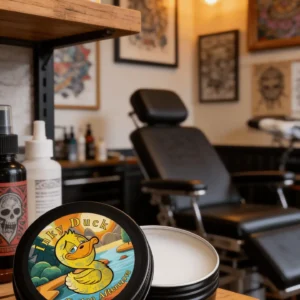
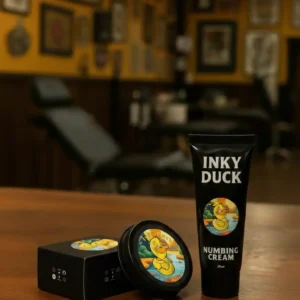
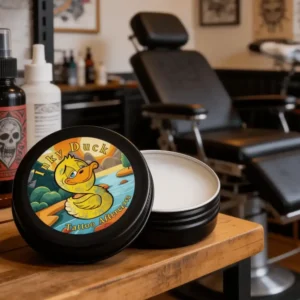
Products like Inky Duck’s tattoo aftercare balm are practical for this handoff. The formula is built around ingredients that support healing without the additives that cause the reactions and complications that generate the most aftercare questions. Handing a client a product you know is well-formulated means the questions about unusual reactions or unexpected irritation are less likely to come up in the first place.
Clear Verbal Instructions
Written aftercare sheets have their place, but verbal instructions at the moment of handoff stick better. Cover three things: how often to apply, how much to use, and what to avoid. Keep it simple, twice a day, thin layer, no picking. Clients can read the detailed sheet later, but the three-point verbal summary is what they’ll remember in the moment.
Setting Realistic Healing Expectations
A significant portion of aftercare questions come not from product confusion but from clients encountering normal healing experiences they weren’t told to expect. Peeling that looks alarming. Itching that seems excessive. The milky phase that makes the tattoo look like it’s fading.
Covering these briefly before the client leaves, “around days three to five it’ll start peeling, that’s normal, leave it alone”, reduces the number of messages that start with “something looks wrong.” A client who was told what to expect is a client who responds to normal healing with confidence rather than concern.
The Studio Operations Side
Making aftercare a consistent part of the post-session routine requires some operational thought, but not a significant one.
Staff Alignment
Every artist on the floor should be making the same recommendation. A studio where one artist recommends the in-house product and another says “just get whatever from the drugstore” sends a mixed message that undermines both the product recommendation and the studio’s credibility. Getting all artists aligned on what to recommend and how to present it is worth the brief team conversation.
Inventory Management
Running out of aftercare product in the middle of a busy week is avoidable with basic inventory monitoring. Setting a reorder point, a minimum quantity on hand that triggers a reorder, means the studio never gets caught without product to sell. For most studios doing consistent volume, this is a simple process once the initial stock levels are established.
Pricing & Point of Sale
The price point for aftercare should be visible and simple, clients making a purchasing decision while holding a freshly wrapped tattoo are not in a position to evaluate complex pricing structures. A clear unit price, the option to buy multiples at a slight discount for longer healing periods, and a straightforward transaction is all the point of sale needs to be.
Reducing aftercare questions is a byproduct of doing what the studio should be doing anyway, giving clients what they need to take care of the work that just left the studio. The operational benefit to artists is real, and the client experience benefit compounds into better healing outcomes, better healed photos, and the kind of client satisfaction that drives referrals and return bookings.