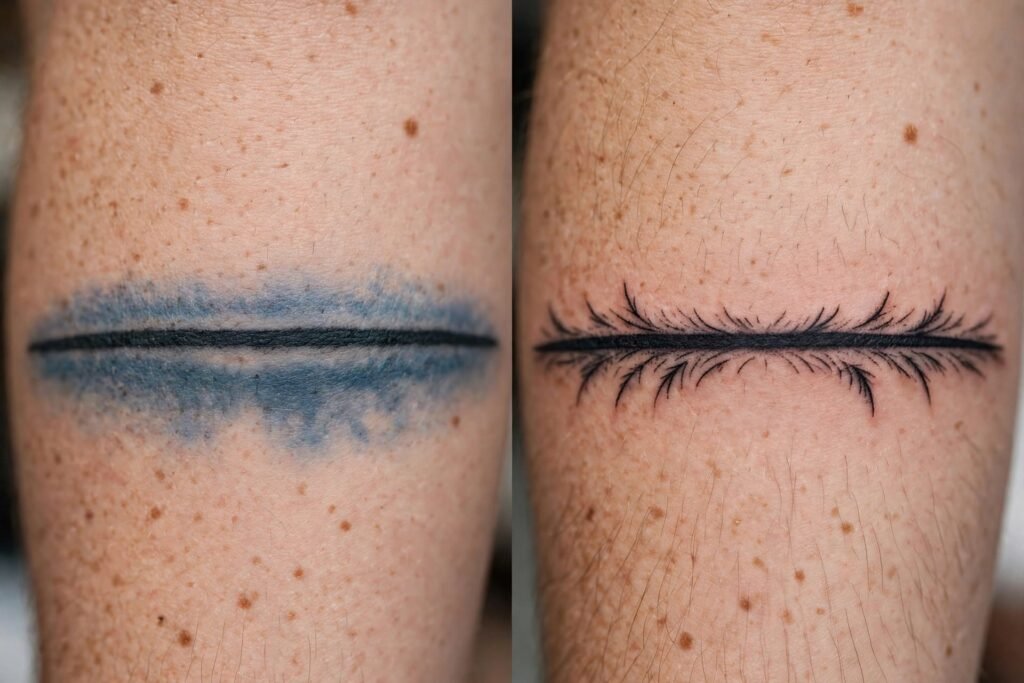
Two of the most common concerns people bring up when something looks off with a healing tattoo are blowout and ink spread. Both involve ink appearing somewhere it doesn’t seem like it should be. Both can look alarming when you first notice them. But they’re different things with different causes, and telling them apart matters if you’re trying to figure out what happened and what your options are.
Here’s how to distinguish between the two, what causes each one, and what you can realistically do about them.
What Tattoo Blowout Actually Is
Blowout happens during the tattooing process itself. It’s not a healing complication, it’s an application issue that becomes visible as the tattoo heals and the skin settles.
When a tattoo needle is pushed too deep into the skin, it deposits ink below the dermis into the subcutaneous fat layer underneath. Ink in the fat layer doesn’t stay where it’s put the way ink in the dermis does. It spreads outward through the fatty tissue, following the path of least resistance, and shows up as a blurry, shadowy halo around the tattoo’s lines or edges.
The result looks like the ink has bled outward from the design, a soft, diffuse shadow sitting just outside where the line or fill was intended to be. It’s most visible on lines and defined edges rather than in shaded or filled areas where the diffusion is harder to detect.
When Blowout Becomes Visible
Blowout is often not immediately obvious right after a session. Fresh tattoos are swollen and the skin is reactive, which can obscure what’s underneath. As the swelling goes down and the skin heals over the following weeks, the spread ink in the fat layer becomes more visible from the surface. Many people notice it around the two to four week mark and assume it happened during healing, but the ink was deposited incorrectly during the session itself.
What Causes It
The most direct cause is needle depth. If the artist pushes the needle too deep, either through technique, an incorrectly calibrated machine, or the natural variation in skin thickness across different body areas, ink goes deeper than it should.
Skin thickness plays a role too. Areas with thinner skin, like the inner wrist, inner elbow, behind the ear, and the ankles, have less distance between the surface and the subcutaneous fat. These areas are more prone to blowout because the margin for error in needle depth is smaller. An experienced artist accounts for this by adjusting their technique on thinner-skinned placements, but it’s one reason these areas carry more risk than meatier placements.
Client movement during a session can also contribute. If the client moves while the needle is in contact with the skin, the needle can be driven deeper than intended or at an angle that changes the deposit depth. Staying still during a session is one of the few things within the client’s control that directly affects this risk.
What Ink Spread Is
Ink spread, sometimes called ink migration, is a different phenomenon. It happens after the tattoo is applied and is related to how ink behaves in the skin over time rather than how it was deposited in the first place.
Over months and years, the ink particles in the dermis can migrate slightly through the tissue. This is a gradual process driven by the body’s ongoing attempts to break down and clear the foreign particles, the natural movement and aging of the skin, and the mechanical forces the skin experiences through daily life. The result is that fine lines become slightly softer, edges become less crisp, and detailed areas lose some of their definition over time.
Ink spread is a long-term process. It happens to virtually every tattoo to some degree, it’s part of how tattoos age. The rate at which it happens depends on placement, skin type, ink quality, sun exposure, and how well the skin has been maintained over time.
How It Differs Visually From Blowout
Ink spread due to aging happens gradually and evenly across the tattoo. The whole piece softens slowly over years. Blowout appears as a localized shadow or halo in a specific area, usually around lines or edges, and is visible relatively early in the healing process.
If you notice a blurry area shortly after the tattoo heals and it’s concentrated around specific lines rather than spread across the whole piece, blowout is more likely. If you’ve had a tattoo for years and notice it generally looking softer and less defined than it used to, that’s age-related ink migration.
The Healing Phase Confusion
There’s a period during healing, roughly weeks one through three, where a tattoo can look blurry or unclear in ways that are completely temporary. A layer of new skin forming over the ink creates a slightly opaque surface that makes everything underneath look hazy. Lines can look thicker or softer than they actually are. Colors look muted.
This is not blowout and it’s not ink spread. It’s just the healing process, and it resolves as the new skin matures and becomes more transparent. Assessing a tattoo for blowout or spread during active healing is unreliable, wait until the skin has fully settled, typically six to eight weeks after the session, before drawing any conclusions about what’s permanent.
Aftercare & Its Role
Aftercare doesn’t cause or prevent blowout, that happened during the session. But good aftercare during healing does affect how clearly you can assess the tattoo once it’s settled, and it affects the long-term skin condition that influences how quickly age-related ink spread occurs.
Keeping the skin consistently moisturized through healing and beyond supports the skin’s structural integrity over time. Products like Inky Duck’s tattoo aftercare balm are designed for exactly this, maintaining hydrated, healthy skin over the tattooed area both during healing and as a long-term maintenance habit. Skin that stays in good condition holds ink more cleanly over the years than skin that goes without regular care.
Sun protection plays a similar role in long-term ink migration. UV exposure breaks down the skin’s structural components over time, which accelerates how quickly ink spreads and softens. Consistent sunscreen use on tattooed areas slows that process meaningfully.
What You Can Do About Blowout
Blowout cannot be fixed with aftercare. The ink is in the wrong tissue layer, and no topical product moves it. There are a few options depending on how significant it is.
Living With It
Minor blowout on small areas is something many people choose to live with, particularly if it’s subtle and not visible at normal viewing distance. As the tattoo ages and the overall piece softens slightly, minor blowout often becomes less noticeable rather than more.
Cover-Up or Rework
For more significant blowout that affects the appearance of the tattoo meaningfully, a cover-up or rework with a skilled artist is the most effective option. An artist experienced in reworks can incorporate the blowout area into a modified design or use shading and additional elements to make it less visible. This requires consultation with an artist who has seen the tattoo in person, photos don’t always capture the full extent of blowout accurately.
Laser Treatment
Laser tattoo removal can be used to target and lighten blowout areas specifically, without removing the whole tattoo. This is a more involved option but works well for significant blowout on otherwise well-executed pieces. It typically requires multiple sessions and consultation with a laser specialist who has experience working on tattoos rather than full removals.
Telling Them Apart — The Quick Version
Blowout: localized shadow or halo around specific lines, visible after healing settles, caused by ink deposited too deep during the session, does not spread further over time.
Ink spread: gradual softening of the whole tattoo over years, affects all areas relatively evenly, caused by natural ink migration in the dermis, part of how tattoos age.
If something looks off in the first few months after a fresh tattoo, give the skin time to fully settle before deciding what you’re looking at. If it’s clearly a shadow around specific lines once the healing is complete, that’s blowout worth discussing with your artist. If it’s a tattoo you’ve had for years gradually looking softer, that’s normal aging, consistent moisturizing and sun protection are the best tools for slowing it down.