
Revenue conversations in tattoo studios usually focus on pricing per piece, booking efficiency, and add-on services. Aftercare products rarely come up in that conversation, which is a missed opportunity. Stocking and recommending quality aftercare is one of the more straightforward ways to add consistent revenue to a studio without adding significant overhead, additional staff, or complicated operations.
Here’s how the math actually works and why the revenue case for aftercare is more compelling than most studio owners initially assume.
The Basic Revenue Model
Aftercare products purchased at wholesale and sold at retail generate margin on every unit sold. For a studio doing consistent volume, that margin adds up across a week, a month, and a year in a way that compounds into meaningful additional revenue.
The math is simple. A tattoo balm purchased wholesale at a fraction of its retail price, sold at retail to every client who gets tattooed, generates consistent margin per transaction. Unlike booking revenue which fluctuates with artist capacity and client scheduling, aftercare revenue scales directly with tattoo volume, every session is an opportunity to sell a product the client genuinely needs.
For a studio doing twenty sessions a week, even a conservative conversion rate, selling aftercare to half of all clients, generates a predictable stream of additional revenue that requires minimal additional effort once the product is on the shelf and the recommendation is part of the standard post-session conversation.
Why the Conversion Rate Is Naturally High
The reason aftercare sells well in tattoo studios, when it’s presented correctly, is that the need and the timing align perfectly. A client who has just gotten a tattoo needs aftercare immediately. They’re already thinking about how to take care of it. The artist they trust just did the work and is now the most credible person in the world to them on the topic of what to do next.
That’s a purchasing environment that most retail situations spend significant effort trying to create and never quite achieve. In a tattoo studio, it exists naturally at the end of every single session.
When the recommendation comes from the artist, not a product displayed on a shelf with a price tag, but a genuine recommendation from the person who just created the tattoo, the conversion rate reflects that trust. Clients who hear their artist say “this is what I recommend you use on it” buy the product. It’s not a hard sell. It’s a natural continuation of the care conversation that every post-session aftercare discussion already involves.
Bundling Aftercare Into the Session Experience
One approach that works well for studios is incorporating aftercare into the session price as a bundle. Rather than presenting aftercare as a separate purchase at the end, including a product in the session fee, and adjusting the session price accordingly, removes the transactional feel and positions the studio as providing a more complete service.
Clients in this model leave with their aftercare taken care of without a separate purchasing decision at the end of an appointment that already involved a financial transaction. The studio captures the aftercare margin in the session price, clients feel they’re getting a more thorough service, and the aftercare conversation becomes about how to use the product rather than whether to buy it.
This approach works particularly well for studios with a strong client retention focus, where the emphasis is on the overall experience rather than individual line items.
The Indirect Revenue Impact
Beyond the direct margin on product sales, recommending and stocking quality aftercare affects studio revenue in ways that don’t show up on a product sales report but are real and significant.
Better Healed Work Drives Bookings
Clients who heal well are clients who are happy with their tattoos. Happy clients book their next piece sooner, refer their friends and family, and leave reviews that drive new bookings. The ripple effect of a good healing experience on future studio revenue is meaningful, even if it’s harder to attribute directly to the aftercare product than a product sale is.
Conversely, clients who have a difficult healing experience, scabbing, infection risk, poor ink retention, often attribute it to the tattoo or the studio even when the issue was entirely in the aftercare. Studios that give clients the right product and the right instructions reduce this risk and the negative outcomes that come with it.
Healed Photos for Marketing
Artists who post healed work on social media are doing some of the most effective marketing available for tattoo bookings. Healed photos show potential clients what they’ll actually be getting, not just the fresh result. Clients who heal well, because they used quality aftercare, produce healed photos that look like the work deserves.
For studios that actively build their social presence around healed work, the connection between aftercare quality and marketing content quality is direct. Better healed photos mean more compelling marketing. More compelling marketing means more bookings.
Choosing the Right Wholesale Partner
The revenue case for stocking aftercare only works if the product is one that clients actually want to buy and that produces the healing results they need. Stocking a product that doesn’t work well, or that clients wouldn’t choose independently, undermines both the revenue opportunity and the studio’s credibility.
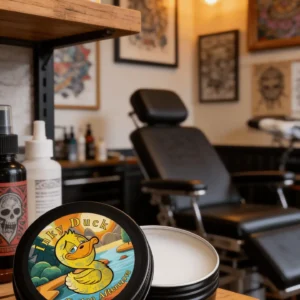
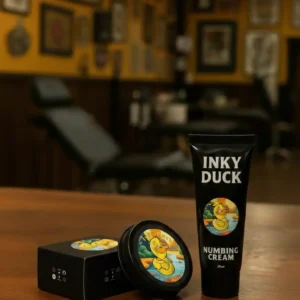
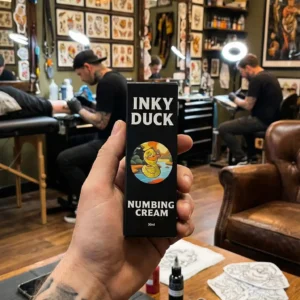
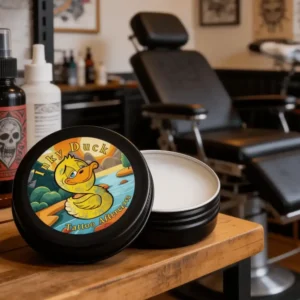
Brands like Inky Duck offer wholesale partnerships that are designed to work within the realities of a tattoo studio, straightforward application process, no excessive minimum orders, products built on ingredients that actually support healing, and a brand story that clients find credible. Veteran-owned, tattoo-community focused, and built around the premise that aftercare should work as hard as the art itself.
These are qualities that matter when the recommendation is coming from an artist who has built their reputation on the quality of their work. Recommending a product with genuine credibility behind it reinforces the artist’s authority rather than putting it at risk.
Making It Part of the Standard Process
The studios that see the most consistent aftercare revenue are the ones that make the recommendation part of the standard post-session routine rather than an optional add-on. Every client who gets tattooed gets a clear aftercare recommendation. Every artist on the floor knows the product and can speak to why they recommend it.
This consistency is what turns a sporadic product sale into a reliable revenue stream. It doesn’t require pressure or a sales-focused approach, just a clear, consistent recommendation delivered by artists who genuinely believe in what they’re recommending, at the moment in the client relationship when that recommendation carries the most weight.