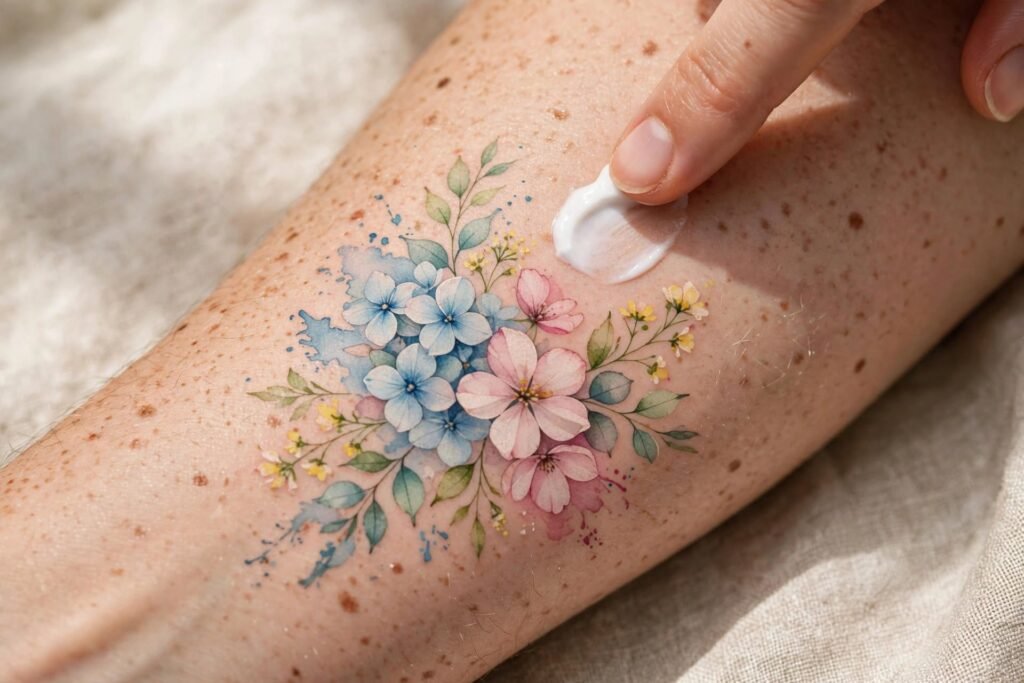
Watercolor tattoos are one of the more visually striking styles in tattooing right now. The soft edges, the color washes, the painterly quality, it’s a style that looks genuinely different from traditional or blackwork pieces. But watercolor tattoos also come with a reputation for fading faster than other styles, and that reputation is largely deserved. Understanding why helps you make informed decisions about aftercare and long-term maintenance.
What Makes Watercolor Tattoos Different Structurally
Most tattoo styles rely on bold outlines to anchor the design. Those outlines are applied with larger needle groupings and deposited with enough ink volume that the lines sit solidly in the dermis for decades. They act as a structural framework that holds the design together as the ink naturally softens over time.
Watercolor tattoos typically avoid heavy outlines or skip them entirely. The design relies on soft color transitions, light washes of pigment, and edges that intentionally bleed into the surrounding skin rather than stopping at a defined line. This creates the watercolor effect visually, but it also means there’s no bold structural anchor holding the design together as it ages.
The ink in watercolor tattoos is also applied more lightly than in bold fill styles. Lighter application means less ink volume in the dermis, which means the body’s immune system, which continuously attempts to break down and clear foreign particles, has less to work against. The result is faster visual fading compared to styles with heavier ink deposit.
Why They Fade Faster
No Outline Structure to Fall Back On
When a traditional tattoo fades over years, the bold outlines remain legible even as the fill colors soften and shift. The design stays readable because the structural lines hold. A watercolor tattoo has no equivalent safety net. As the soft color washes fade and the light pigment deposits break down, the design loses definition without a structural framework to maintain it.
This doesn’t mean watercolor tattoos look bad as they age, many people find the softened, faded quality suits the style. But it does mean the change happens faster and more dramatically than with outline-based styles.
Light Pigment Application
The deliberate lightness of watercolor application, the thin washes and soft gradients that define the style, uses less ink than solid fill or heavy shading. Less ink means faster fading under the same environmental conditions. UV exposure, skin turnover, and immune processing all affect lighter ink deposits more quickly than dense ones.
Placement Choices
Watercolor tattoos are often placed on areas with higher skin movement, forearms, wrists, shoulders, ankles. These areas experience more mechanical stress from daily movement, which accelerates how quickly ink migrates and softens in the tissue. Placement compounds the inherent fading tendency of the style.
Aftercare That Actually Makes a Difference
The Healing Period Is Critical for Watercolor
Because watercolor tattoos have less ink volume to begin with, any ink lost during healing has a proportionally larger effect on the final appearance than it would on a bolder piece. Heavy scabbing pulling ink out of a traditional tattoo leaves a light spot that can be touched up. Heavy scabbing pulling ink out of a soft watercolor wash can eliminate an entire gradient.
This means aftercare during healing needs to be more consistent and attentive for watercolor work than for other styles. Keeping the skin moisturized from day one to prevent heavy scabbing is the most impactful thing you can do. A well-formulated aftercare balm applied consistently, something like Inky Duck’s tattoo aftercare balm, which is built around skin-safe ingredients without the additives that cause reactions on healing skin, gives the ink the best conditions to settle properly without disruption.
Do not pick at peeling skin. Do not scratch. The lightness of watercolor application means there’s less margin for ink loss during healing than with bolder styles.
Sun Protection From Day One
UV exposure is the single biggest environmental driver of fading in watercolor tattoos. The light pigment deposits in watercolor work break down under UV radiation faster than dense, heavy ink deposits. A watercolor tattoo that heals well but gets regular unprotected sun exposure will look noticeably more faded at the one-year mark than one that has been consistently protected.
During healing, keep the tattoo covered from direct sunlight entirely. After healing, apply broad-spectrum SPF 30 or higher whenever the tattoo will be exposed. For watercolor tattoos on regularly exposed areas like forearms, making sunscreen part of the daily routine rather than an occasional measure is worth doing from the point the tattoo heals onward.
Long-Term Maintenance
Moisturize Consistently
The condition of the skin over a watercolor tattoo affects how the remaining ink reads visually. Dry skin makes light ink deposits look even more faded than they are. Consistently moisturized skin keeps the surface in the condition that lets whatever ink remains show through as clearly as possible.
Daily moisturizing with a fragrance-free product is a small habit that makes a real difference in how watercolor work holds up visually over years.
Expect Touch-Ups
Most watercolor tattoos need touch-ups within a few years, and many artists who specialize in the style build this into the conversation at the consultation stage. Touch-ups on watercolor work refresh the color washes and soft gradients that have faded most significantly. Staying in contact with your artist and scheduling a touch-up assessment at the one to two year mark is a reasonable approach for most watercolor pieces.
Choose Placement Carefully for Future Work
If you’re planning a watercolor tattoo and haven’t gotten it yet, placement significantly affects longevity. Areas with less sun exposure and less mechanical movement from daily activity hold watercolor work longer. Inner upper arm, upper back, and areas that can be easily covered when outdoors tend to show slower fading than forearms, wrists, and other high-exposure placements. Watercolor tattoos are worth getting if the style appeals to you, just go in knowing what the maintenance commitment looks like and set up the aftercare and sun protection habits from day one.