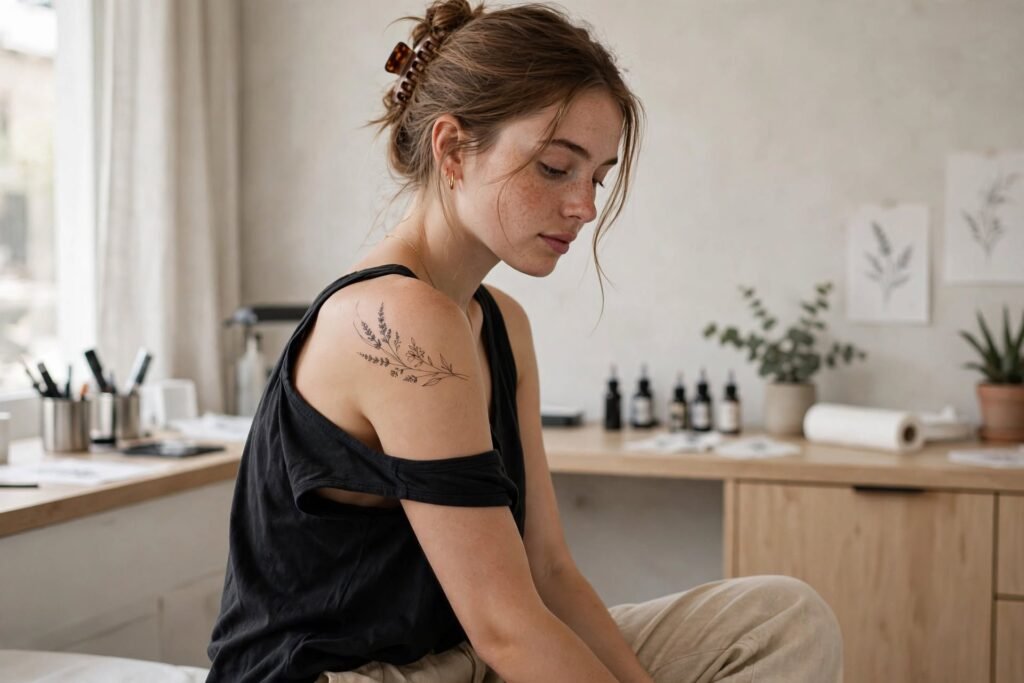
Clothing choice for a tattoo appointment sounds like a minor detail, and for short sessions on easy placements, it pretty much is. But for longer sessions or placements that require specific positioning, what you wear genuinely affects how comfortable the session is and how easily the artist can do their work.
Getting this right takes about two minutes of planning and makes the whole experience more straightforward for everyone involved.
The Basic Principle
Whatever you wear should give the artist clear, unobstructed access to the area being tattooed without requiring you to be uncomfortable or awkwardly positioned for the duration of the session. Clothing that needs to be held out of the way, pinned back, or worked around adds friction to a process that should be as straightforward as possible.
Beyond access, comfort matters, especially for longer sessions. You may be sitting or lying in the same position for several hours. Tight, restrictive clothing that feels fine for a normal day can become uncomfortable quickly when you’re stationary and unable to adjust freely.
Clothing by Placement
Arm & Forearm
For upper arm, elbow, and forearm work, a sleeveless top or a short-sleeved shirt that can be pushed up easily is the obvious choice. Loose-fitting sleeves are better than tight ones because they can be pushed up and stay without cutting into the arm.
Avoid tight long-sleeved shirts for arm work. Rolling a tight sleeve above the elbow and keeping it there for hours is uncomfortable and can restrict circulation to the arm. If you want the option of some sleeve for warmth on the non-tattooed arm, layering is a better solution than a tight long sleeve on both arms.
Chest & Sternum
Chest and sternum work requires comfortable access to the front of the torso. For this placement, wearing a button-up shirt that can be opened easily is a practical choice for anyone who doesn’t want to remove their top entirely. A loose tank top that can be moved out of the way also works.
Bras with clips or front closures are easier to manage for chest placements than pull-over sports bras. Some placements may require removing the bra entirely, your artist will let you know what’s needed for your specific design before the session starts.
Back & Spine
For back work, a top that can be removed easily or a loose button-up worn backward is practical. If you’re comfortable without a top, that’s the simplest solution for full back sessions. A robe or loose wrap can be used to cover the front while the back is being worked on.
Hair should be tied up and secured away from the placement area. Long hair that falls across the back during a session needs to be moved out of the way repeatedly, which disrupts the artist’s workflow and gets in the way of the work.
Ribs & Side
Rib and side placements require access to the torso from the side. A top that can be rolled up or removed easily is the most practical option. For longer rib sessions, wearing a separate top and bottom rather than a one-piece makes repositioning and access much simpler.
Thigh & Hip
Loose shorts or athletic shorts that can be pulled up are the most practical choice for outer thigh work. For inner thigh or hip placements, loose shorts or a wrap skirt that can be adjusted as needed gives the artist access without requiring you to be in an awkward or uncomfortable position for the full session.
Avoid jeans for any leg or hip placement. Denim is stiff, doesn’t move easily, and won’t roll or pull up the way softer fabrics do. For any lower body placement, soft, loose-fitting fabric is significantly more practical.
Feet & Ankles
For foot and ankle work, shoes and socks obviously come off. Bring footwear that slips on and off easily, sandals are the obvious choice. After the session, the tattooed foot or ankle needs to be kept clean and protected, and getting a fresh tattoo on your foot back into a closed shoe is worth thinking about before you leave for the appointment.
Neck & Behind the Ear
For neck placements, wear a low-neck top or one that doesn’t have a collar that competes with the area being tattooed. Hair should be tied away from the neck and secured so it stays in place without needing adjustment during the session.
Colors & Fabrics Worth Thinking About
Dark clothing is worth considering for any session. Tattoo ink, stencil solution, and the products artists use during sessions can transfer onto fabric, and these stains don’t always wash out completely. Wearing something dark means any transfer isn’t visible, and wearing something you don’t mind getting marked is always the safer call.
Soft, breathable fabric is more comfortable for longer sessions than stiff or synthetic materials. Natural fabrics like cotton that breathe and move with you are better choices than tight synthetics, particularly if you’re going to be in the same position for several hours.
After the Session
The clothing you wear home from a session matters too. Fresh tattoos need to breathe and should not be rubbed by tight fabric during the drive or journey home. Wearing loose clothing over the tattooed area protects it without pressing against the fresh work.
If your tattoo is in an area where the clothing you wore to the session will press against it on the way home, bring a change into something looser, or bring a clean cloth to lay over the area for the drive.