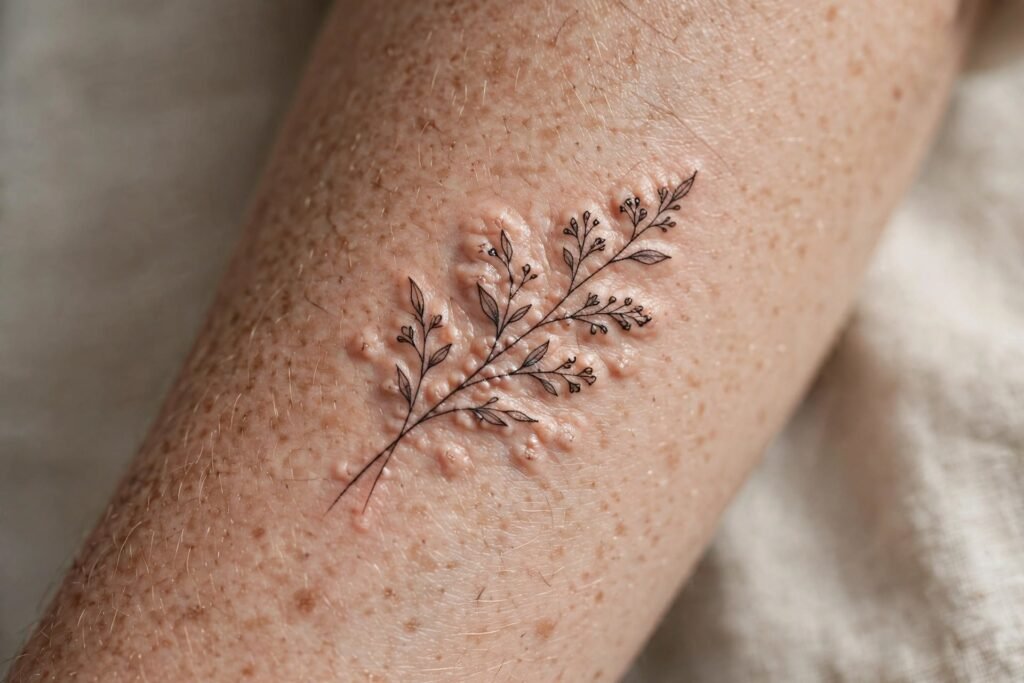
Finding that your tattoo is raised or bumpy after it has healed is one of those things that catches people off guard. The peeling is done, the redness is gone, the tattoo looks settled, and then you run your hand over it and feel texture that wasn’t there before, or notice that certain lines or areas are sitting above the surrounding skin. It can feel alarming, especially if everything seemed to be healing normally up until that point.
The good news is that raised tattoos are common and in most cases not a sign that anything serious went wrong. There are several reasons this happens, and most of them are manageable or resolve on their own over time. Understanding what’s behind the texture helps you figure out which category your tattoo falls into and what, if anything, needs to be done about it.
Scar Tissue Formation
The most common reason a tattoo feels raised after healing is scar tissue. Tattooing is a controlled form of skin trauma, the needle punctures the skin thousands of times, and the body responds to that trauma by producing collagen as part of the repair process. In most cases that collagen production is proportionate and the skin heals flat. In some cases the body produces more collagen than needed, and the result is a slightly raised texture over the tattooed area.
Hypertrophic Scarring
Hypertrophic scarring is a type of raised scarring where excess collagen forms within the boundary of the original wound. On a tattoo, this shows up as raised lines or areas that follow the tattoo’s design. The ink looks fine but the skin over it sits higher than the surrounding tissue.
Hypertrophic scars often improve on their own over months as the collagen remodels. Keeping the area moisturized supports that process. Silicone-based scar treatments are sometimes used to help flatten raised scar tissue, and these can be applied over a fully healed tattoo.
Keloid Scarring
Keloid scarring is less common but more significant. Unlike hypertrophic scarring, keloids grow beyond the boundary of the original wound and can continue to expand over time. People with a personal or family history of keloid formation are at higher risk of developing them after tattooing.
If a raised area is growing beyond the edges of the tattoo design, feels firm, and continues to grow rather than stabilizing, that is worth having assessed by a dermatologist. Keloids on tattoos are treated the same way as keloids elsewhere, options include corticosteroid injections, silicone sheeting, or in some cases minor procedures. This is a medical situation rather than something to address with aftercare products alone.
Ink Overload in the Skin
Another reason tattoos feel raised is that the artist worked an area heavily, depositing more ink than the skin could optimally absorb in a single pass. Areas with dense shading, heavy color packing, or multiple passes over the same section can develop a slightly raised texture as the skin heals around a higher concentration of ink particles.
This is more common in areas that were worked hard during the session and tends to be most noticeable in the first several months after healing. As the skin continues to mature and settle, the texture often improves. It’s not always something that fully resolves, but it typically becomes less pronounced over time.
Allergic Reaction to Ink Pigments
Raised texture that appears specifically in colored areas of a tattoo, particularly in red, yellow, or other bright pigments, can indicate an allergic reaction to the ink. Tattoo ink allergies are not always immediate. Some develop months or even years after the tattoo was done, which is part of what makes them confusing to identify.
An allergic reaction to ink typically presents as raised, itchy, or inflamed skin concentrated in the areas containing the reactive pigment. The surrounding skin and areas with different colors may look and feel completely normal while the reacting areas are visibly elevated and uncomfortable.
Red ink is the most commonly associated pigment with allergic reactions, partly because of the compounds historically used to achieve red pigmentation. Modern ink formulations have improved, but reactions still occur.
If raised texture is isolated to specific colors and accompanied by itching or inflammation that doesn’t settle, seeing a dermatologist is the right move. Treatment options include topical corticosteroids or in more persistent cases, other medical interventions. This is not something aftercare products resolve on their own.
Sun Exposure on Healing or Healed Skin
UV exposure on a tattoo, particularly during or shortly after healing, can trigger an inflammatory response in the skin that results in raised texture. The skin over a tattoo is more reactive to UV than surrounding untattooed skin, partly because of the ink particles present in the dermis and partly because of how the healing tissue responds to radiation.
Repeated sun exposure on a tattoo without protection can cause ongoing low-level inflammation that keeps the skin in a reactive state. This shows up as raised, sometimes itchy texture that comes and goes, often worse after sun exposure and better when the tattoo is consistently protected.
Keeping the tattoo out of direct sun and using broad-spectrum sunscreen once the skin has healed reduces this significantly. For people who notice their tattoo raises up after sun exposure specifically, UV protection is the most direct way to address it.
Weather & Temperature Changes
Some people find their tattoos raise up during cold weather, hot showers, or temperature changes. This is a relatively common experience and is generally not a cause for concern. The skin over a tattoo can behave differently from surrounding skin in response to temperature because of the ink and scar tissue present in the dermis.
Cold causes the skin to contract, which can make tattoo lines feel more pronounced and raised to the touch. Heat causes vasodilation and slight swelling, which can also make a tattoo feel more textured. These changes are temporary and not a sign of a problem with the tattoo itself.
Skin Type & Individual Healing Differences
Some people simply scar more readily than others, and some skin types are more prone to raised healing. Darker skin tones have a statistically higher tendency toward hypertrophic scarring and keloid formation, which is worth knowing before getting tattooed in terms of placement and style choices.
Skin that was worked very hard during a session, with lots of passes, heavy saturation, or aggressive technique, is more likely to heal with some raised texture regardless of skin type. Areas with thinner skin, like the inner arm or ribs, sometimes develop more texture than areas with more substantial tissue beneath.
When to See a Doctor
Most raised tattoos fall into the category of normal healing variation or minor scarring that improves over time. The situations that warrant medical attention are when the raised area is growing beyond the tattoo boundary, when it’s accompanied by ongoing inflammation and itching that doesn’t settle, when there’s any discharge or signs of infection, or when the texture is getting worse rather than stabilizing or improving.
For everything else, texture that is stable, not growing, not inflamed, and not causing significant discomfort, consistent moisturizing, sun protection, and time are the most practical approach. Most raised tattoos look and feel better at the one-year mark than they did at the two-month mark, as the skin continues to remodel and settle.